Tuesday, July 17, 2012

Electronic Pollution

Besides pollution around the world in terms of dangerous gases or toxic substances, humanity is now facing a 21st century problem, one much more closer to every modern society - Electronic pollution.


Televisions, computers, mobile phones, radios etc. All these electronic devices may not seem harmful at first sight. However, imagine millions of households multiplied by the number of electronic devices you have in your own household today, think of all the electronic emissions and radio signals.

Day by day this problem is slowly progressing right under our noses, as the air further saturates with satellite broadcasts and such. Wireless remote controls... Radiation from microwaves... These electronic devices have been created for our ease, yet the amount of emissions being emitted into the air every second may just threaten our health. This problem is not widely acknowledged, and society today is overly complacent about this issue.

Several known effects due to this rising issue includes 'psychological complaints including confusion, panic, paranoia, strong mood swings and violent or aggressive behaviour'


Perhaps this modern problem is being brushed aside due to the sheer impossibility of convincing every man on Earth to refrain from using electronic devices which produce large amounts of negative emissions. Technology has become such a large part of mankind that some people would not be able to survive without it. Another possible reason may be because of the cost involved to design radiation-reducing phenomenons of sorts. After all, in my opinion, scientists today would very much prefer investing money into curing cancer, a world-known illness, rather than preventing 'oh-so-dangerous electronic pollution'.


Sunday, July 15, 2012

Air pollution in China

China's pollution now is not so much because of mining, but from coal-fired power plants, heavy industry, large amounts of construction being done and its traffic congestions. The quality of China's air is declining due to the increase in cars and heavy industries which emit harmful gases into the air, polluting it. 

These two pictures show the difference between air pollution in the Beijing Vs the air condition it is in now.


China tries to improve the air quality in Beijing by closing down factories and controlling the number of cars on the road by allowing them to drive on certain days. Chemical plants, power stations and factories that did not close down, had to cut emissions by 30% and construction work there was temporally stopped. Public transport prices were dropped to encourage people to take public transport and discourage people, at the same time, to purchase cars. These efforts by the Chinese government has significantly decreased the amount of air pollution in the city.

Saturday, July 14, 2012

Pollution in India


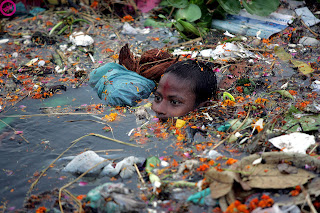
India is one of the top 10 countries that face water pollution. Three billion litres of waste is thrown into the Yamuna River in Delhi, India and this is what the residents in the area have to deal with every day. Can you imagine yourself trying to row your boat to the other end of the river? It is clearly difficult as the entire surface layer of the river is filled with trash. Can you even think of what more waste and trash lies underneath the surface? This problem of pollution in the Yamuna River is a small scale of pollution in India as 80% of the waste in India goes to nearby rivers and other bodies of water for disposal. It's like multiplying the amount of pollution in Yamuna River by more than 10 times! Thus, more than 128 million people in India lack access to safe drinking water.

The government has spent half a billion US dollars to clean the river, however, due to its neglect of sufficient sanitation measures and its failure in creating a functional sewage system. The major problem that the people in India face is the bad condition of the city's sewer system which enables waste to be delivered to the sewage treatment plants.

People find it interesting that the river Ganges is known to be sacred to the Hindus as a goddess whose purity cleanses the sins of the faithful, but it still remains as one of the most polluted rivers in the world.


This picture shows a boy in India swimming through the garbage and waste which pollutes many of India's rivers
This picture shows a boy on a boat that could be picking up litter or searching through the litter for something of value which he can sell. In the background is litter on the surface of the river. 

Wednesday, June 20, 2012

Textbook Page 81!

Air transport has definitely improved many folds over the years. The article on page 81 of the Geog textbook  shows how from weak, crash-likely airplanes, the idea of air transport has spread its wings to fly with the B-777-200LR aircraft. This airplane outshines others with its incredible ability to travel nearly 3000 more kilometres than them, carrying 301 passengers up to 17 466 kilometres in distance. Instead of stopping over at transport hubs for maintenance and refueling, this aircraft can travel half the globe without having to rest. Built for long distances with perhaps larger fuel tanks, more durable material and certainly more humans who can sit in their seats for hours, this aircraft has provided a platform for more research on allowing airplanes to travel further and faster.

The most obvious advantage of this plane is that because it is built for long distances, much time and money is saved. Less flight transits would result in hours saved, attracting more passengers as most people would want to arrive at their destination as quickly as possible. Money is saved as well because these planes would be built to last through long flights, meaning less maintenance and hiring less people to maintain these aircrafts. However, on the down side, airline companies purchasing the 777-200LR may profit less. Although the plane provides direct flights, attracting many customers whom are willing to pay a higher fee for the time saved, each plane can only cater to the number of people going to that specific destination. Also, direct flights are likely to be less frequent, considering the long distance travelled. Whereas, cheaper transit flights would attract a much wider range of passengers ranging from those going to that destination itself, to those taking another flight from that same destination. Also, these transit flights are likely to be more frequent, so if passengers miss a flight there would always be another available soon. 

Thursday, May 17, 2012

China VS Singapore


Recently, I have chanced upon an article regarding the transportation statics comparison between Singapore and China. I find this piece of news extremely interesting as it involves the difference in terms of transportation services both countries provided.

In my opinion, prior to reading the article, I would say that comparing these two countries can be a little unfair because firstly, China is so much bigger than Singapore and secondly, China is still a developing country with many undeveloped and rural villages while Singapore is a developed country. Hence, I think that China must be at the losing end when compared.

However, the end result was quite unexpected. Singapore was ranked 127th in 2005 whereas China was ranked 79th in 2005, which was so much higher than Singapore.  This stats comparison further emphasized on the rapid speed that China is developing at.  

Link to Comparison Stats:

Monday, May 14, 2012

Singapore as a Transport Hub


Singapore as a Transport Hub


Singapore has an extremely efficient transport services system for every single mean of transport (Land, Air, and Sea).


Land Transport

In terms of Land Transport, bus services are catered to meet the needs of all the commuters; there is an inter-connected network of roads and expressways which link up the country, thus enabling convenience and maximum accessibility to all places. Boards are put up to show bus arrival timings so that commuters are aware and the “waiting time” is saved.


The second mean of Land Transport is the MRT. Once again, the routes are inter-connected and there is an extremely efficient system which allows members of the public to navigate easily around Singapore at affordable prices.


Taxis are available everywhere as well to bring people around. However, there might be cases of serious congestion (peak hour period), thus Road Pricing System is implemented to control the numbers of cars entering the city area.


Air Transport

There are 4 terminals catered to provide services to 50 countries, thus enabling international connectivity. Budget airlines encourage tourism and cost-efficient travel, makes Singapore a place of transit and provides more opportunities for travel. This system facilitates businesses ventures and in return boost economy.


Sea Transport

PSA International is the main port operator that seeks to provide world-class services. These excellent services are vital in building up the successful partnerships as more people choose to stop over at Singapore to rest and replenish. It provides an efficient crew, high-technological machines (cranes/containers) for the consumers, reaching out to over 600 ports globally.  

Sunday, April 8, 2012

The Sunday Times 8 April 2012- Where has the crowd gone?

In this article on page 10, it talks about how the amount of business in Holland Village after the opening of the Holland Village MRT, has not increased but in fact, decreased. Though many people came to Holland Village, only a small number were shoppers. Some shop owners even felt that due to the initial surge of people that came to Holland Village, their regular customers were scared off as they did not want to compete with them to shop there. Shopper say however, that the limited variety of shops and hawker centre stalls are the cause of its decrease as well.

I feel that transport routes are increasing in Singapore and it is easier for us to get around to places. However, because of that, the competition between different shopping areas and eateries are in turn, getting more competitive. People would rather go to a further place with a larger number of shops and stalls that cater to their needs compared to a nearer place where shops are limited and they are unable to get what they want. The transport in Singapore allows them to get to a further place with convenience though it may not be as fast as going to the place that is nearer. But there are downfalls to this system as it would cause more crowds in that area and lead to a traffic congestion due to the amount of cars travelling on the same road.

A wide transport network may be good or bad for a city, it's just the level of importance that you place each benefit or problem.